
Back Pain Treatment in Manchester & Cheshire
Altibury Health helps patients experiencing persistent back pain in Manchester and Cheshire access independent consultant spinal specialists. Whether your symptoms developed gradually, followed an injury or continued despite physiotherapy or other care, your treating consultant will assess your symptoms and explain appropriate options.
Treatment is tailored to your symptoms, examination findings and individual circumstances, with non-surgical approaches considered wherever appropriate.
Specialist Back Pain Care Focused on Finding the Cause
Back pain can arise from several structures within and around the spine, but in many cases no single anatomical cause can be identified. Specialist assessment helps identify concerning conditions, assess any nerve involvement and consider which treatments may improve symptoms and function. Changes visible on scans do not always explain pain.
Altibury Health facilitates access to consultant-led spinal appointments. The individual consultant is responsible for clinical evaluation, recommendations and any subsequent treatment.
- Assessment by consultant spinal specialists
- Expertise in both common and complex spinal conditions
- Non-surgical treatment explored wherever suitable
- Existing MRI, CT and X-ray scans can be reviewed
- Access to minimally invasive spinal techniques for appropriate patients
- Personalised recommendations based on symptoms, imaging and lifestyle
- Appointments available for self-pay and insured patients
The independent spinal consultants available through Altibury Health assess a range of conditions, including mechanical and disc-related back pain, spinal stenosis, spondylolisthesis, nerve compression and more complex spinal disorders.
What Can Cause Back Pain?
Back pain is extremely common and does not always indicate a serious spinal problem. In many cases, symptoms improve with time and appropriate conservative care.
When pain continues, becomes more severe or starts to affect normal activities, further assessment may help identify what is contributing to the problem.
Possible causes of back pain can include:
- Muscle or soft-tissue strain
- Age-related changes within the spine
- Disc degeneration
- A slipped or herniated disc
- Arthritis affecting the spinal joints
- Spinal stenosis
- Spondylolisthesis
- Irritation or compression of a spinal nerve
- Injury or spinal trauma
- Less commonly, infection, fracture or another underlying condition
Some people experience pain mainly in the lower back, while others develop symptoms that extend into the buttock or leg. Numbness, tingling or weakness may suggest that a spinal nerve is also involved.
Back Pain Treatment Options
The most appropriate treatment depends on the cause of your symptoms, how long they have been present, how much they affect everyday life and whether there are signs of nerve involvement or another underlying condition.
Physiotherapy & Conservative Treatment
Many episodes of back pain can be treated without surgery.
Depending on your diagnosis, treatment may include maintaining appropriate activity, physiotherapy, rehabilitation exercises, changes to activities that aggravate symptoms, medication review or specialist pain-management support.
The aim is not simply to reduce discomfort, but to improve movement, confidence and function wherever possible.
Are Spinal Injections Appropriate for Back Pain?
Spinal injections are not routinely recommended for non-specific lower back pain. NICE guidance advises against spinal injections for the management of low back pain alone.
There are important distinctions for selected conditions. Epidural local anaesthetic and steroid injections may be considered for acute, severe sciatica. Some patients with chronic localised lower back pain may be assessed for radiofrequency denervation after unsuccessful non-surgical treatment and, where indicated, a positive diagnostic medial branch block.
Your consultant will explain whether an intervention is appropriate, its expected benefits and limitations, and what alternatives are available.
Surgery for Back Pain
Most people with lower back pain do not require an operation. Surgery is generally not recommended for non-specific mechanical lower back pain.
Surgery may be considered for selected clearly defined spinal conditions, particularly where nerve compression causes substantial leg symptoms or neurological problems and where clinical and imaging findings support a likely benefit.
Management must be individualised, including careful consideration of non-surgical options. Symptoms suggesting cauda equina syndrome must be assessed immediately through NHS emergency services rather than a routine private appointment.
Independent spinal consultants accessible through Altibury Health may provide microscopic, minimally invasive, endoscopic or complex spinal procedures according to their own expertise and clinical practice. Your treating consultant will explain whether an operation is indicated and which approach may be suitable.
What Happens During a Back Pain Consultation?
Your consultation is designed to build a clear picture of your symptoms and identify whether further investigation or treatment may be helpful.
Your spinal specialist will usually:
- Ask when your back pain began and how it has changed
- Discuss where the pain is located and whether it travels into the legs
- Ask about numbness, tingling or weakness
- Review how symptoms affect work, sleep, walking and everyday activities
- Discuss previous physiotherapy, medication or other treatment
- Examine spinal movement and relevant neurological function
- Review existing MRI, CT or X-ray scans where available
- Explain the likely cause of your symptoms in straightforward language
- Discuss appropriate non-surgical and surgical treatment options
- Recommend further investigations if required
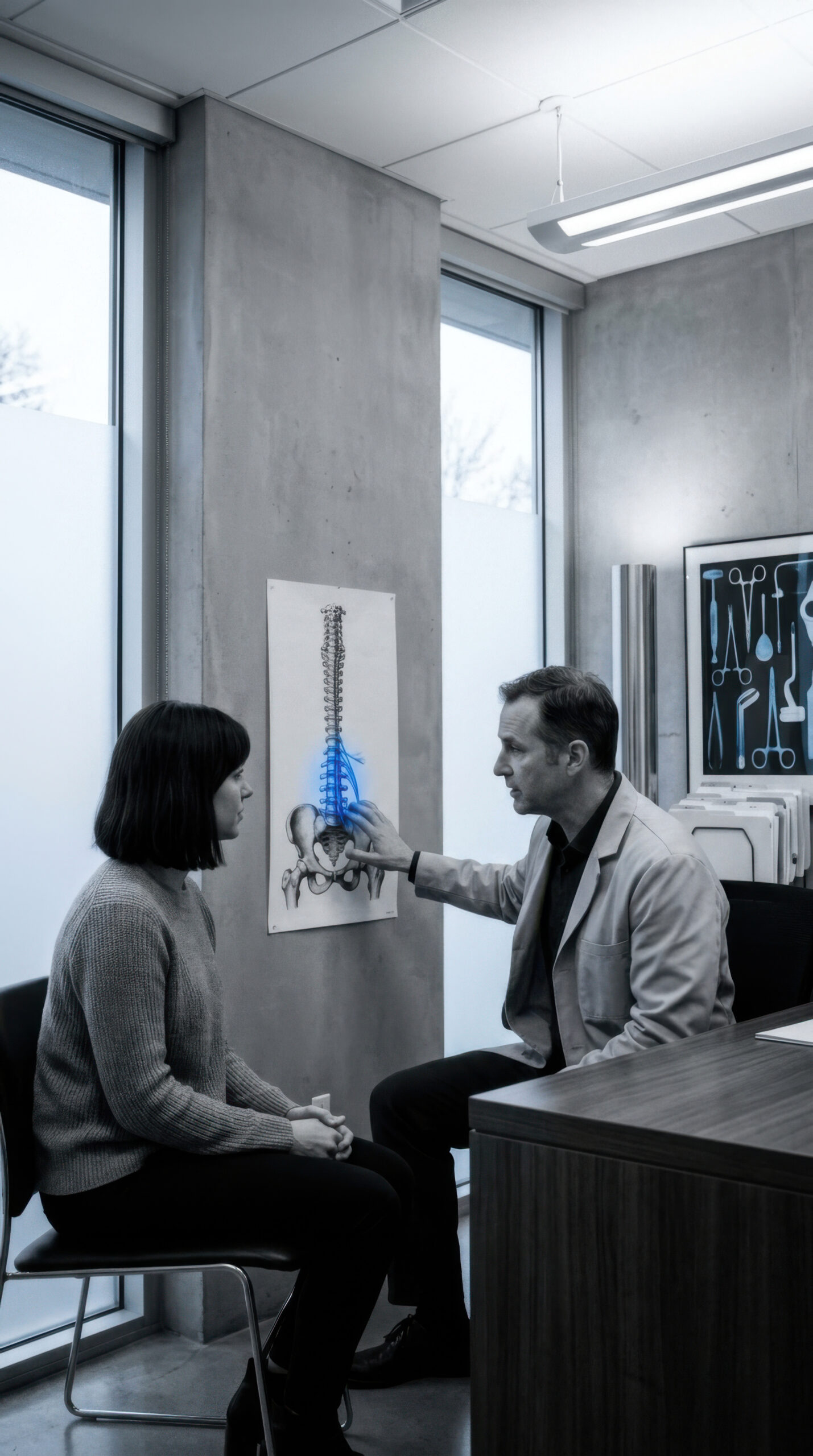

If you already have scans, reports, clinic correspondence or a current medication list, bring these with you where possible.
When Back Pain Needs Emergency NHS Assessment
Most back pain is not an emergency. However, certain NEW symptoms may indicate cauda equina syndrome or another serious spinal problem and need immediate assessment at an NHS Accident & Emergency (A&E) department.
Seek EMERGENCY NHS CARE IMMEDIATELY if you develop any of the following:
- New difficulty starting or passing urine, or inability to empty the bladder
- New loss of bladder or bowel control, or reduced awareness of bladder filling
- New numbness or altered sensation around the genitals, anus, bottom or inner thighs (saddle area)
- New severe or rapidly worsening weakness in one or both legs
- New significant loss of leg sensation, especially with other symptoms listed above
- Severe back pain following major trauma, particularly with neurological symptoms
These symptoms may indicate cauda equina syndrome or another spinal emergency. ATTEND YOUR NEAREST NHS A&E DEPARTMENT IMMEDIATELY. Do not wait for a routine GP appointment, an Altibury Health consultation or a reply to an enquiry. If you cannot get to A&E safely, call 999.
Back pain with fever, unexplained illness or other concerning features also needs prompt medical assessment. If you are seriously unwell, seek emergency NHS care.
Frequently Asked Questions
How Long Should Back Pain Last Before I See a Specialist?
Many episodes of back pain improve over several days or weeks. Specialist assessment may be appropriate when pain continues despite suitable treatment, repeatedly returns, becomes progressively worse or significantly interferes with mobility, sleep, work or everyday life.
Earlier assessment may also be appropriate if you develop leg weakness, numbness or other neurological symptoms.
Do I Need an MRI Scan for Back Pain?
Not everyone with back pain requires an MRI.
Imaging may be recommended when symptoms have persisted, when examination suggests nerve involvement or another spinal condition, or when the result could influence treatment.
If you already have an MRI, CT scan or X-ray, your specialist can usually review the images and reports during your consultation.
Does Back Pain Mean I Have a Slipped Disc?
No. A slipped or herniated disc is only one possible cause of back pain.
Symptoms can also arise from joints, muscles, ligaments, age-related spinal changes or other conditions. Some disc changes are visible on scans without causing any symptoms at all, which is why imaging needs to be interpreted alongside your medical history and examination.
Will I Need Surgery for Back Pain?
Usually not.
Many back problems can be managed through physiotherapy, rehabilitation, activity modification, pain management or other non-surgical approaches.
Surgery is generally considered only when there is a specific condition that can be treated surgically and when the likely benefits justify the procedure.
Can Back Problems Cause Leg Pain or Sciatica?
Yes. When a spinal nerve becomes irritated or compressed, symptoms can travel from the lower back into the buttock, thigh, leg or foot.
This is commonly described as sciatica and may be accompanied by tingling, numbness or weakness.
Can the Consultant Review My Existing Back Scan?
Yes. Existing MRI, CT and X-ray images and reports can usually be reviewed during your specialist appointment.
Further imaging may be recommended if your scans are old, your symptoms have changed or the available images do not provide enough information to guide treatment.
Arrange a Specialist Assessment for Persistent Back Pain
Back pain that continues to interfere with walking, sleep, work, exercise or everyday life can be difficult to manage without understanding what is causing it.
A consultation with an independent spinal specialist can help clarify possible causes of symptoms and whether rehabilitation, pain-management support, further investigations or, for selected conditions, an intervention or surgery may be appropriate.
Altibury Health helps patients arrange access to independent consultant spinal specialists. Assessment, treatment recommendations and any procedures are provided by the treating consultant, with a focus on avoiding unnecessary intervention.